A visual doorway
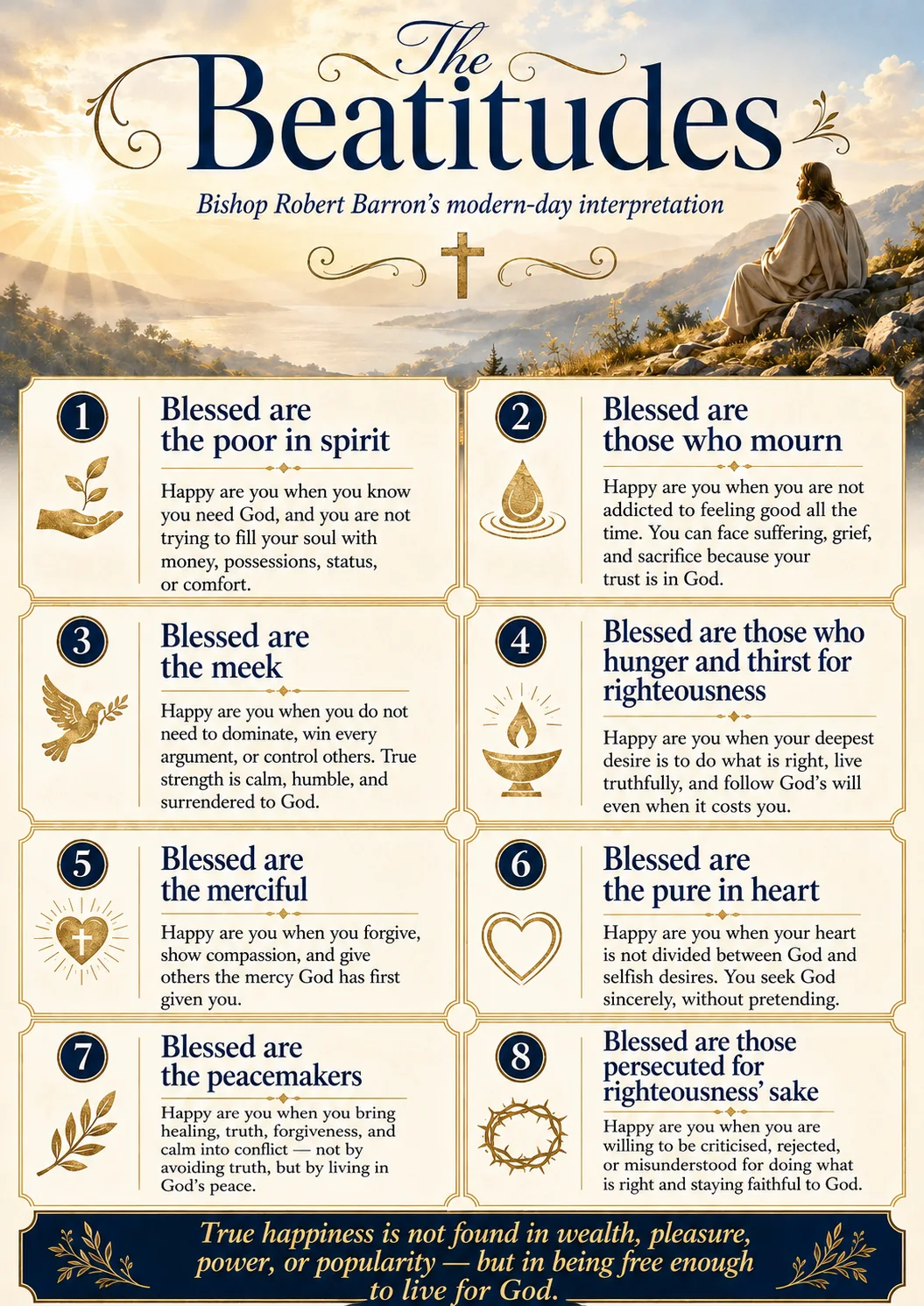
The Beatitudes can sound beautiful and impossible at the same time. Jesus blesses the poor in spirit, the mourners, the meek, the merciful, the pure in heart, the peacemakers, and the persecuted. He is not romanticising misery. He is revealing a kind of happiness the world cannot manufacture and cannot take away.
Read them first as a self-portrait of Christ. Jesus is poor in spirit before the Father, merciful to sinners, pure in heart, gentle and meek, hungry for righteousness, a maker of peace, and persecuted for the kingdom. Then read them as an invitation: grace can make this same pattern visible in us.
How to pray the Beatitudes
- What is Jesus showing me? The Beatitudes show the face of Jesus and the surprising freedom of the kingdom.
- How can I sit with the words? Choose one Beatitude and ask where Jesus lived it perfectly.
- Which blessing can I practise? Turn one Beatitude into a concrete act of mercy, peace, honesty, or humility today.
Blessed are the poor in spirit, for theirs is the kingdom of heaven.
The eight blessings in plain language
Poor in spirit
I stop pretending to be self-sufficient. I come to God with empty hands and discover that need can become prayer.
Explore this blessing2Those who mourn
I can tell the truth about grief, sin, loss, and the pain of the world because God meets sorrow with comfort, not contempt.
Explore this blessing3The meek
I do not need to dominate every room, argument, or relationship. Strength becomes calm because it is surrendered to God.
Explore this blessing4Hunger for righteousness
I want what is right more than what is convenient. Holiness becomes hunger, not merely rule-keeping.
Explore this blessing5The merciful
I give to others the mercy I have first received. Forgiveness becomes a way of living inside God’s generosity.
Explore this blessing6The pure in heart
I ask for an undivided heart: one that seeks God sincerely instead of splitting life into holy and hidden compartments.
Explore this blessing7The peacemakers
I bring truth, patience, courage, and mercy into conflict. Peace is not avoidance; it is love working to heal what is broken.
Explore this blessing8The persecuted
I learn that faithfulness may cost comfort, approval, or status, but belonging to Christ is worth more than being applauded.
Explore this blessingWhy the Beatitudes overturn ordinary success
The Beatitudes overturn false pictures of happiness. They do not say that pain is good in itself, or that weakness is holiness by itself. They say that life with God can be blessed even when the usual signs of success are missing.
This is liberating for seekers because it means Christianity is not simply a technique for becoming impressive. It is a path into freedom: freedom from needing to be rich, admired, in control, invulnerable, entertained, or always proven right.
Open the Scripture
Read the passage slowly. Notice the repeated promise: the kingdom of heaven, comfort, inheritance, satisfaction, mercy, seeing God, being called children of God, and great reward. Jesus is not only giving commands. He is announcing what God gives.
Catechism to consult
The Catechism calls the Beatitudes the heart of Jesus’ preaching. They show the goal of human life, the character of Christian holiness, and the surprising route to true happiness.
How this connects to Mass and Catholic life
The Beatitudes are not meant to stay on a poster. Catholic life keeps placing them inside worship and daily practice. At Mass, the Liturgy of the Word forms the mind with Scripture, and the Liturgy of the Eucharist forms the heart by communion with Christ. That is where the Beatitudes become more than ideals: they become the pattern of a life received from Jesus.
When you hear the readings at Mass, listen for Beatitude-shaped movements: God lifting the lowly, calling for mercy, purifying desire, making peace, and giving courage under pressure. When you examine your conscience, ask where you are resisting this pattern. When you pray the Liturgy of the Hours, let the psalms teach the same poverty, mourning, trust, mercy, and hope.
Deeper notes on each Beatitude
1. Poor in spirit
The temptation: I can secure myself by control, money, achievement, image, or spiritual performance.
The grace: I can stand before God truthfully, without pretending to be my own saviour.
Practice: Begin prayer with one honest sentence of need: Lord, I cannot give myself life. Teach me to receive.
2. Those who mourn
The temptation: I must stay distracted, numb, cheerful, or busy so sorrow cannot reach me.
The grace: Christian mourning lets grief become prayer and repentance become hope.
Practice: Name one sorrow before God without fixing it immediately. Ask for comfort that deepens love rather than avoidance.
3. The meek
The temptation: I must win, dominate, interrupt, prove, or protect myself by force.
The grace: Meekness is strength under God, not weakness under fear.
Practice: In one conversation, choose listening before defending yourself.
4. Hunger and thirst for righteousness
The temptation: I want holiness only when it costs little, keeps approval, or feels inspiring.
The grace: God can make goodness into hunger, not just obligation.
Practice: Choose one concrete act of justice, honesty, purity, generosity, or reconciliation today.
5. The merciful
The temptation: I want mercy for myself and strict accounting for others.
The grace: Mercy does not deny evil; it refuses to let evil have the last word.
Practice: Pray for someone you resent. If appropriate and safe, take one step toward peace.
6. The pure in heart
The temptation: I divide life into public faith and private compromise.
The grace: Purity of heart is an undivided desire for God, formed patiently by grace.
Practice: Ask what most competes with God for your attention, secrecy, or loyalty.
7. The peacemakers
The temptation: I confuse peace with silence, avoidance, people-pleasing, or winning the argument.
The grace: Christian peace joins truth and charity so that wounds can actually heal.
Practice: Bring one conflict to prayer and ask what truth needs charity, and what charity needs courage.
8. The persecuted
The temptation: I measure truth by comfort, popularity, or whether it costs me anything.
The grace: Belonging to Christ can become dearer than approval.
Practice: Ask where you are tempted to hide your faith or soften what love requires.
A simple way to pray them
Choose one Beatitude each day. Do not try to master all eight at once. Ask:
- Where do I resist this blessing?
- Where did I see this in Jesus?
- Who in my life already lives this quietly?
- What one small action would make this Beatitude concrete today?
Lord Jesus, make my idea of happiness more like yours. Teach me the freedom of the Beatitudes and form in me a heart that belongs to your kingdom. Amen.
A seven-day path
Use this as a slow next step after the first read:
- Day 1: Read Matthew 5:1-12 and choose one Beatitude.
- Day 2: Read the deeper note for that Beatitude and write one sentence of prayer.
- Day 3: Follow the Order of Mass guide and notice where Scripture and Eucharist meet.
- Day 4: Open the daily Mass readings and listen for one Beatitude-shaped word.
- Day 5: Make a brief examination of conscience using mercy, purity, and peace.
- Day 6: Pray one decade of the Rosary or one station of the Cross with this Beatitude in mind.
- Day 7: Choose one concrete act: mercy, peace, honesty, apology, generosity, or patient endurance.
For families and children
Use the artwork as a conversation page. Let a child choose one panel, describe the image, and name one action: forgive someone, tell the truth gently, pray for someone sad, make peace after an argument, or ask God for help.
Keep the explanation concrete: Jesus is teaching us what a blessed heart looks like.
#jesus #holiness #beatitudes